Ten of Swords Card Meaning
Swords
- Upright Keywords
- painful endingrock bottomcompletionthe hour before dawn
- Reversed Keywords
- recoveryrefusing the endingsigns of rising
- Yes / No:
- No
Ten of Swords: Yes or No?
No
No. The Ten of Swords is a definitive ending and one of the deck's plainest negatives — the matter is finished rather than blocked. The consolation is that nothing worse follows it. Reversed it points to a slow recovery already beginning.
Overview
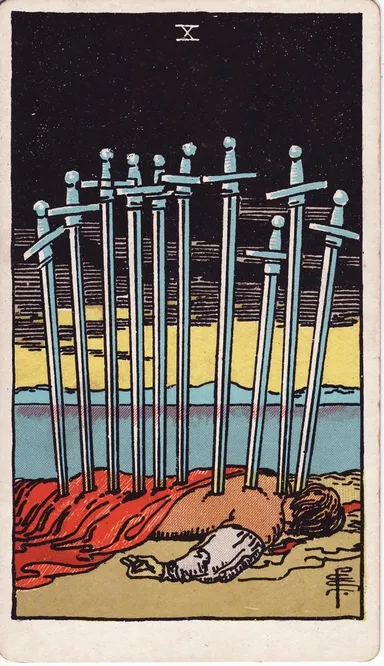
The Ten of Swords closes the numbered Swords cards with one of the most dramatic images in tarot. In the Rider-Waite scene, a figure lies face down at the water’s edge with ten swords standing in his back. Half the sky is black — but along the horizon, a golden dawn has already begun to spread, and the sea is strangely, completely calm.
One sword would have been enough; ten is deliberate exaggeration, and it carries the card’s hidden message: this situation is finished, so thoroughly that nothing is left to get worse. That is why the Ten of Swords is, paradoxically, a card of relief. If you have touched bottom, the only remaining direction is up — and the dawn breaking at the edge of the darkness makes that promise on the card’s behalf.
Upright Meaning
Upright, the Ten of Swords speaks of an unmistakable ending — a relationship concluding, a project running aground, an expectation collapsing past repair. The card does not gift-wrap this. It acknowledges plainly that this is a hard passage.
It also names the unexpected gift inside completion. The energy spent clinging to a half-alive hope is released the moment the ending is admitted, and it turns, of its own accord, toward recovery. If the worst has already happened, then the uncertainty is over too. When this card appears, the counsel is not to resuscitate what has fallen, but to gather what the ending taught you and turn your body toward the brightening side of the sky.
Reversed Meaning
Reversed, this card is often read as the first stirring of recovery: the situation that hit bottom is slowly improving, wounds are closing, and the strength to stand is returning. A long-drawn pain is approaching its genuine conclusion.
The other reading is the refusal of an ending — staying camped outside a door that has already closed, or holding a failing thing upright because admitting failure feels like total collapse. But strength spent gripping what is ending cannot be spent beginning. The reversed Ten of Swords asks its hardest, kindest question: is what you are protecting still alive, or is only the announcement of its ending being postponed?
In Love Readings
In love questions, the Ten of Swords can mean the painful closing of a chapter — a breakup, the shock of a betrayal, or the recognition that the old way two people relate has stopped working. It is not, however, a death sentence for every romance it touches. When what ends is not the relationship but its outworn pattern, this card becomes the starting line for rebuilding on honest ground.
Reversed, ask which side of the line you stand on: healing steadily from a loss, or still holding a relationship that has already ended. For reconciliation questions, its advice is exacting — measure not by the warmth of leftover feeling but by whether the reasons the relationship failed have actually changed. Dawn does not rise behind the person looking backward; it rises in front of the one facing forward.
In Career & Money Readings
For work and career, the Ten of Swords can mark a definitive close: a project shut down, a contract expiring, sometimes a departure that was not your choice. It hurts — yet this ending is usually the confirmation of a long decline, not a sudden catastrophe. Write down what the ending taught you as you clear the desk; that list becomes the map for the next position.
With money, it may mean a loss finally realized, an investment that needs to be closed out, or a spending pattern due for its own funeral. Accepting a loss is not failure — it is the decision that prevents the larger loss. Reversed, finances are lifting off the bottom; just pace the recovery, because the rushed attempt to win everything back at once is how fresh wounds get made.
🔍 Reading the symbols
Tarot feels hard less because the keywords are hard to memorise than because it is unclear where in the picture they come from. This table draws the line between the two.
| In the picture | What it points to |
|---|---|
| Ten swords in the back | One would have sufficed. The excess also hints at exaggerated despair. |
| Right hand in benediction | Even fallen, the fingers form a blessing. This ending carries meaning. |
| Gold at the horizon | The sky is lightening below. Rock bottom leaves only up. |
| Still water | The quiet that follows the worst. Nothing left to get worse. |
| Black sky | The darkest hour — and specifically the one that is ending. |
🔗 When it appears with other cards
↗ Cards that sharpen it
- Death It is fully over. Attempts at revival are wasted.
- Five of Pentacles Two bottoms overlap. Recovery takes longer.
↘ Cards that pull against it
- The Sun The sun rises on the ruin. Recovery is faster than expected.
- Ace of Wands A new spark catches in the wreckage. The next thing begins.
A starting point, not a verdict. The real reading shifts with your question and the position.
💬 What actually happened
Tell us what really happened on a day this card came up. You can read what others recorded too.
Nothing here yet. Be the first to write one.