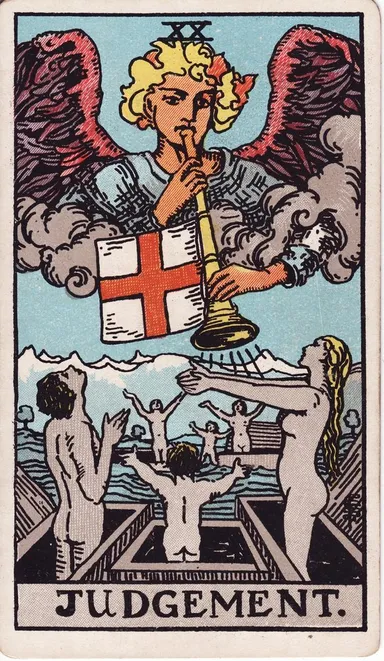
Judgement Card Meaning
Major Arcana
- Upright Keywords
- awakeningreckoningsecond chancescalling
- Reversed Keywords
- self-judgmentignored callingstalled closure
- Yes / No:
- Yes
Judgement: Yes or No?
Yes
Yes. Judgement answers affirmatively for anything involving a return, a revival, or a decision that has been building for a long time, and it favours acting on what you already know. Reversed it reads as no while an honest reckoning is still being avoided.
Overview
High among the clouds, the archangel Gabriel blows a great trumpet from which hangs a banner bearing a red cross. Below, the sea holds floating coffins, and from them the dead are rising — a man, a woman, a child in the foreground, and more figures behind — all gray-skinned, all with arms open or lifted toward the sound. Snow-capped mountains line the far horizon. No one in the image looks afraid; every face is turned upward in something like relief.
Despite its name, this card is not about being judged from outside. It is about the summons — the trumpet-note of truth that wakes people out of the boxes they have been lying in. Card 20 gathers the whole journey of the Major Arcana into one reckoning: the past reviewed honestly, its lessons claimed, and a rising into a larger life that was always on the other side of that honesty.
Upright Meaning
Upright, Judgement marks a moment of awakening and evaluation. Something calls you to rise — a vocation finally admitted, a truth about your life acknowledged, a chapter formally closed with its lessons banked. The card often accompanies verdict-moments in the neutral sense: results announced, applications answered, long processes reaching their conclusion. Its counsel is to meet the reckoning standing up, because you have more to show for your history than you think.
It is also the deck’s great second-chance card. The figures rise from coffins, not cradles: what seemed finished — an ambition, a relationship, a version of yourself — may be offered one genuine renewal. Answer the trumpet; it rarely blows twice for the same door.
Reversed Meaning
Reversed, the trumpet is sounding and the coffin lid is being held shut from inside. This usually takes one of two forms. The first is harsh self-judgment: replaying old failures on a loop, denying yourself the absolution you would grant anyone else. Review without mercy is not honesty — it is just another way of refusing to rise.
The second form is the unanswered calling: the change you know is yours to make, deferred season after season because rising feels costly. The reversed card notes, without cruelty, that the coffin gets no roomier with time. Its remedy is a real accounting — write down what actually happened, what it taught, what it cost, what you owe and are owed — followed by deliberate forgiveness, of others and especially of yourself. Then answer the call at whatever volume you can manage.
In Love Readings
In love, Judgement often brings the past forward for resolution — a returning person, an old pattern surfacing for final review, or a couple honestly assessing what their history amounts to and choosing what rises from it. Handled bravely, this is renewal: many relationships find a genuine second act once both people stop litigating the first. For singles, the card favors closing old accounts — grief completed, lessons named — so that new love is not asked to pay historical debts.
Reversed, watch for verdicts issued without trial: condemning a partner on old evidence, or condemning yourself as unlovable on older evidence still. Release is the theme either way. Some connections are meant to rise again, and some are meant to be blessed and left in the water — honesty tells you which.
In Career & Money Readings
Professionally, Judgement attends evaluations, results, and callings: performance reviews, exam outcomes, promotions decided, and — most importantly — the deeper question of whether your work matches your actual vocation. It is a powerful card for career rebirth: retraining, returning to a field you abandoned, or finally pursuing the purpose you keep describing as “someday.” Past experience, under this card, is not baggage; it is testimony in your favor.
With money, it favors the full reckoning — a complete, honest review of accounts, debts, and habits, followed by a clean restart rather than incremental tinkering. Old financial mistakes lose their power once fully faced and factored in. Reversed, avoid both endless self-punishment over past losses and the refusal to open the statements at all. The audit you are dreading is almost always more survivable than the dread.
🔍 Reading the symbols
Tarot feels hard less because the keywords are hard to memorise than because it is unclear where in the picture they come from. This table draws the line between the two.
| In the picture | What it points to |
|---|---|
| The angel with the trumpet | A summons. You did not start this; the situation called it. |
| Figures rising from coffins | Rising again. Something you considered finished is moving. |
| Arms opened upward | A posture of acceptance — response rather than resistance. |
| The grey sky | Feeling stripped out of the view. A time for cool review. |
| The cross banner | A mark of ordering. Scattered things are being lined up. |
| The snowy peaks behind | The hard road travelled. That is what this judgement rests on. |
🔗 When it appears with other cards
↗ Cards that sharpen it
- The World One chapter closes as the next opens. The move toward completion is clear.
- Ace of Cups Feeling begins again. An old connection may return in a different shape.
↘ Cards that pull against it
- Eight of Cups Looking back against walking away. Decide whether you settle it or just go.
- Five of Cups The call meets regret. Nothing gets answered while you are blaming yourself.
A starting point, not a verdict. The real reading shifts with your question and the position.
💬 What actually happened
Tell us what really happened on a day this card came up. You can read what others recorded too.
Nothing here yet. Be the first to write one.