Five of Swords Card Meaning
Swords
- Upright Keywords
- conflicthollow victorybattle of egostension
- Reversed Keywords
- thread of reconciliationlingering resentmentending a fight
- Yes / No:
- No
Five of Swords: Yes or No?
No
No, or a yes that costs more than it returns. The Five of Swords describes winning at the expense of the relationship around it, so even a favourable outcome here tends not to be worth claiming. Reversed it points toward stepping back and letting it go.
Overview
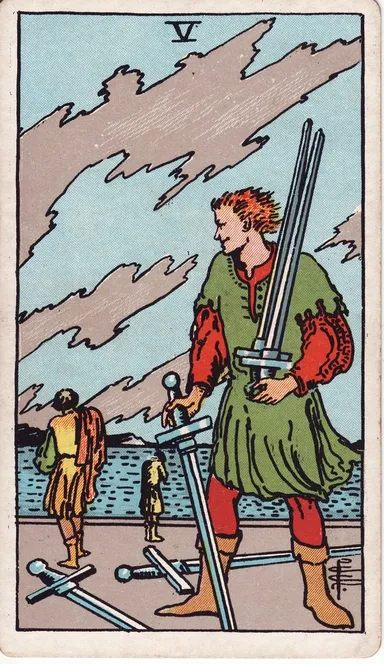
The Five of Swords opens onto a windswept shore just after a fight has ended. In the Rider-Waite scene, a man gathers three swords into his arms with an ambiguous smirk while two more lie abandoned on the ground. In the distance, two figures walk away with slumped shoulders, and ragged clouds tear across the sky.
The victor holds every blade, yet his expression carries no real satisfaction — and no one remains beside him. This is the card of the battle that was won and lost at the same time. More than the conflict itself, the picture asks an honest question: after the fight, what is actually left?
Upright Meaning
Upright, the Five of Swords marks a period of heightened conflict and tension. Disagreements escalate into contests of pride; the urge to win sharpens words past the point of usefulness. If you have recently won an argument and still feel a knot in your stomach, you are standing in the middle of this card.
It does not tell you to avoid every fight. It tells you to price the fight. Put what this victory gains on one side of the scale and what it costs on the other — and if trust or a relationship sits on the losing side, then stepping back is a form of skill, not surrender. Not every battle deserves to be won; that is the Five of Swords’ hard-earned advice.
Reversed Meaning
Reversed, the card looks at the tail end of a conflict. A long-running quarrel is asking to be closed; a thread of reconciliation appears; the courage to set pride down and extend a hand first becomes available. Leaving the fallen swords where they lie — and simply walking off the beach — becomes a real option.
There is a shadow reading too. The fight may look finished on the surface while resentment settles quietly underneath, or you may be replaying the loss on a loop, unable to let it go. A conflict buried without an apology tends to reopen on its own schedule. The reversed Five of Swords insists that a true ending is not a final score — it is an emotional settling of accounts.
In Love Readings
In love questions, the Five of Swords warns that arguing has started to erode the relationship itself. Nitpicking each other’s words, reopening old cases, punishing with silence — when these patterns repeat, neither person is winning; both are losing together. If the card represents a partner, they may currently be defending a position rather than listening.
Reversed, it can signal that the wish to end the fighting is growing on both sides. The needed shift in perspective: the one who apologizes first is not the loser, but the one who values the relationship more. That said, if a recurring pattern keeps causing the same wound, name the pattern before making peace — otherwise the truce inherits the war.
In Career & Money Readings
For work and career, this card points to workplace tension, disputes over credit, and competition running hot enough to burn the team. In a politicized atmosphere, whoever wins the argument, the group as a whole tends to lose. The stronger strategy now is to step off unnecessary battlefields and let the quality of your work do the arguing.
With money, it cautions against disputes over shared funds and against spending driven by rivalry. In a partnership disagreement, settle things through records and agreed principles rather than raised voices. Reversed, a financial dispute may be entering its closing phase — but keep verifying documents and terms to the very last signature.
🔍 Reading the symbols
Tarot feels hard less because the keywords are hard to memorise than because it is unclear where in the picture they come from. This table draws the line between the two.
| In the picture | What it points to |
|---|---|
| The smirk | He won and it isn't clean. That expression is the card's warning. |
| Two figures walking off | The victory cost people. Relationships were the price. |
| Two swords on the ground | They had already disarmed. The fight continued past its end. |
| Three swords in one hand | He took everything. Sharing was never the plan. |
| Torn sky | The weather is bad despite the win. This result leaves an aftertaste. |
🔗 When it appears with other cards
↗ Cards that sharpen it
- Seven of Swords Winning by any means. Trust takes a serious cut.
- The Devil Caught in the need to win. Victory becomes the point in itself.
↘ Cards that pull against it
- Temperance There is a route that resolves without winning. Stepping back pays.
- Two of Cups The relationship is worth more. Scoring this fight loses you money.
A starting point, not a verdict. The real reading shifts with your question and the position.
💬 What actually happened
Tell us what really happened on a day this card came up. You can read what others recorded too.
Nothing here yet. Be the first to write one.